
May 19, 2026


Cats are one of the most popular domestic pets in the world. Nevertheless, despite their cute looks and lovable nature, it can be quite challenging to train felines owing to their inherent nature. However, as it turns out, there are various tricks that will enable you to train your cat. Below are some useful tips that you can consider.
First, let us consider peculiarities of the behavior of cats that should be taken into account while training this species. According to scientists, the behavior of any animal is influenced by both instinctual and environmental factors. Moreover, each cat possesses individual features which have a significant impact on its behavior and actions.
In particular, cats are not able to communicate verbally; instead, they express their moods and feelings through various actions. Thus, rubbing against you, meowing, or hissing indicate that your cat is satisfied. This is why it is important for a person to be attentive and sensitive to the needs of his/her pet.
Apart from this, as you know, cats learn things using trial-and-error method which is aimed at associating consequences with certain actions. In terms of the theory of operant conditioning, the main motivators for learning are rewards and punishment. This is why you are likely to obtain better results if you reward your pet for its proper behavior.
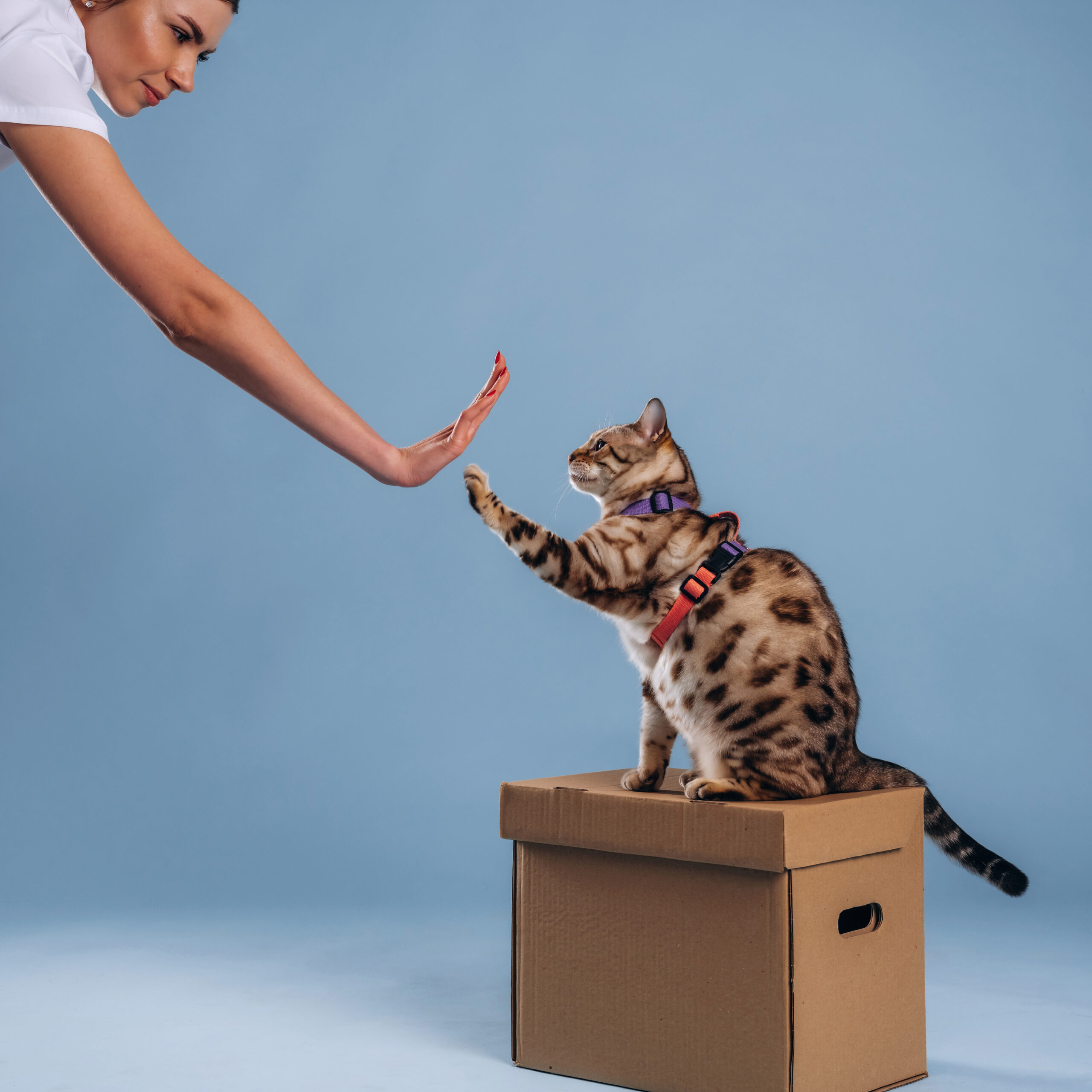
Now that you know about behavioral and learning peculiarities of cats, we would like to tell you about various tricks for their training. Generally speaking, all of these tricks involve rewarding your pet for desirable actions. Such techniques include positive reinforcement training, clicker training, and lure training.
Positive reinforcement is a rather easy and widespread way of training cats. As we mentioned earlier, it presupposes rewarding your cat for performing desirable actions.
At first, you should define desirable actions and pick appropriate rewards for your pet. It may be snacks, games, and various toys depending on your cat’s preferences. High-calorie snacks or treats are usually recommended because they provide high incentives for your pet. Do not forget about taking into account the needs of your pet while choosing a reward.
Another technique for training cats is called clicker training. It consists in rewarding certain actions of your pet when a clicking sound is produced. Before starting training a command, it is essential to associate clicking with a reward; you can do it by giving treats after making sounds with a clicker.
Then, to teach a new command to your pet, you should give a click and a command. Next, in case of a successful execution of the command, reward your cat.
Apart from this, another useful trick for cat training includes luring your pet by using various treats to make it execute desirable actions.
This method is quite effective when teaching a complex command which includes several actions. However, you should not force your pet – instead, you should motivate it to do what is expected from it. Once it starts learning a command, you can stop using lures.
As you already know, while training cats, you should give it rewards to make it perform certain actions. In addition to rewarding your pet, it is recommended to use various cues which refer to gestures accompanying commands and places where your cat should be located upon hearing these commands.
It is important to use cues gradually, beginning with the simplest commands. Working with your pet’s cues requires patience and attention from your side; you should encourage your pet each time it performs a desirable action and gives you an incentive to work with it further.
As we noted above, when teaching your cat, you can reward it using various treats or games. Tasty snacks, toys, and interesting games are considered high-value rewards for felines.
While using this trick for training, you should be careful in choosing rewards for your cat. Pay much attention to your pet’s tastes in snacks, games, and toys. If your pet does not like a particular kind of a treat, you can opt for other treats; e.g., catnip toys. Moreover, you should reduce the number of rewards step by step once your cat begins learning the commands.
Certainly, when training your cat, you can encounter some obstacles. One of the most common challenges associated with training includes refusal of your pet to obey you because it is frightened or angered. In such cases, you should find ways of helping your pet relax; never punish it in order not to make it even angrier. Also, you can try luring your pet using treats. If nothing helps, you can alter your training program.
Furthermore, sometimes, it happens that your pet refuses to perform certain actions because of lack of incentives. You can increase the number of rewards for your cat; this measure can be rather effective in overcoming this challenge. Additionally, you can replace one type of a reward with another or increase the frequency of giving them to your pet. Finally, if these measures fail, you might need to shorten your training routine.
As we mentioned in our paper, there are lots of ways of training cats effectively. First, we advise you to use rewards for desirable actions and commands. Apart from this, you can use cues which should be introduced gradually.